Immersion Therapy
Engine test stand run. You will be exposed to the flood of information that is generated on the most advanced engine test stand in the world, The Carl Goulet Memorial Engine Test Facility. We do not expect anyone to grasp all that they see during their first glance at the wonders of the GAMI computers or all of the things happening inside a combustion chamber in real time but this initial exposure to the source of the most reliable data available will make the next two days more meaningful. Do not underestimate the importance of this experience. It will forever change, in a fundamental way, how you "think" about your engine. This is true whether or not you are an experienced "engine head" or a novice to piston engines.
Engine Management 101
"Landmarks on the Way to Understanding Piston Engine Management" is an intense session to focus your mind on the small group of graphs which every pilot, mechanic or flight instructor must know and understand to be able to effectively manage, maintain, or teach a piston power plant. We bring you this understanding of what the knowledgeable pilot sees in his mind's eye when he moves the prop, throttle or mixture controls. Once you understand these five simple "traces" on one fundamental graph, you will never think of your engine the same way again.
Flying the Data
"In-Flight videos." We will show in-flight videos of how we operate our engines. The APS instructors produced these videos to show how easily the classroom principles you will be learning are applied in the real world of General Aviation. You will see the multi-probe engine monitor in use as well as the GoFast and GoFar modes we will be discussing.
Reality vs. the Data
"Mixture Sweep" A very short data stream from an IO-520 in flight showing the real effects of the mixture control on EGT, CHT and FF as an engine is slowly leaned from full rich to 60dF lean of peak EGT is shown. This data is presented as a practical confirmation of what was presented in the Landmarks to Understanding Piston Engine Management and is an eye-opener for most participants. It is a beautiful confirmation of the physics involved.
Engine Monitors
"Understanding the Engine Monitor." A thorough explanation of multi-probe engine monitors, how they work, how to interpret the information they are displaying, and how to use them to trouble shoot in-flight problems will be shown in detail. You will be taught how to accomplish a safe and very diagnostic in-flight mag check as well as recognize various failure modes. No one can properly understand how to use and interpret an engine monitor without having gone through the basics of 101 earlier in the day. Nowhere else, but in the APS class is this education available.
Engine Management 201
"Controlling the Beast." We present a thorough discussion of what the pilot can control and what effects such things as the prop, throttle, and mixture have on the combustion event. These issues build on the foundation of the "Landmarks" you learned earlier and you will begin to see what effects engine control movement have on the combustion event and the health of your engine. You will gain a thorough understanding of what determines horsepower output when rich of peak and when lean of peak as they are not at all the same. This is a major revelation to most pilots and alters the way power is understood as it relates to engine longevity.
Engine Run
You will see, in real time, the pressure traces generated by the combustion event , and how they are affected by everything learned earlier in the day. You will see the effects of timing changes and how this can change the entire operational range of general aviation piston engines. You will observe detonation, in real time, on a running engine. (It's like pornography; hard to define, but you will know it when you see it!) From this point on, you will never think of your engine the same way as you always have as this is only place in the world these phenomenon can be observed in a teaching environment.
Now What?
"Using What you've learned." A selection of of important real-world scenarios will be shown whereby you will be applying the new information you have learned and which we have been discussing. These are real, in-flight issues which have been brought to us by pilots for the answer to "Uhh, what just happened?" Some events you will have seen before in your own airplane and possibly not recognized them; others you will hope you will never see. There's nothing quite like having previously seen a problem in helping you deal with it when it happens to you.
Real-Time Quiz
We will challenge your new skills with a display of data from an engine monitor taken from a real "event." If you correctly figure out what to do (if anything) or not do, and when in response to this challenge, you will know that you have joined the ranks of the all too few pilots who truly understand their engine monitor and how they can properly control the events going on inside their engines. The room always gets really quiet when this presentation starts!
Detonatino & Pre-ignition
"Recognizing & Avoiding the Catastrophic event" Next, we will present the details and scientific explanations of these two events which are frequently confused, often used interchangeably, misused, and are not at all the same event. One event is much more benign than most pilots think and the other is much more destructive than most realize. You will learn how to control these events and stop them should you experience them.
Fried Valves
"The Unabashed Truth about Valves." We take on all the mystery about valve problems and explains the real source of the problems. You will see bad valves and examine the causes of the failure. You will also learn what the pilot can do (and can't do) to affect the health of his engine's valve train.
Engine Management 301
"Putting it all Together” A summary of how to apply what you've learned is a fun way to wrap up the weekend. We will discuss how to read a POH and which information is accurate and which is misleading. You will learn which parts of the POH are trustworthy and which may have been market-driven and how to decide which recommendations to follow in the event that your POH has conflicting information within it.
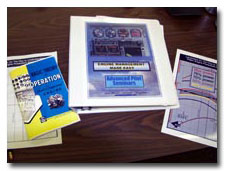
A comprehensive package of reference materials is provided to each student.
"After 4,000 hours of flying single, multi, instuments, and float planes, this seminar was the single most interesting and valuable two days I have spent in Aviation." -- Fred Scott, Baron Owner
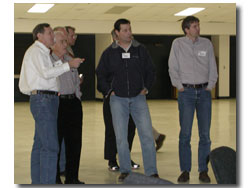
There is ample time for one on one discussion with the instructors.
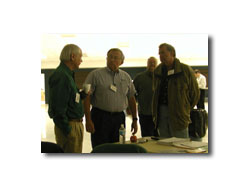
"Saturday was, frankly, all really hard work. On Sunday, we tried to integrate all of that new found knowledge back into the every day operation of our engines."
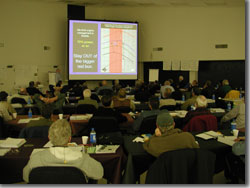
Class presentation.


 HOME
HOME